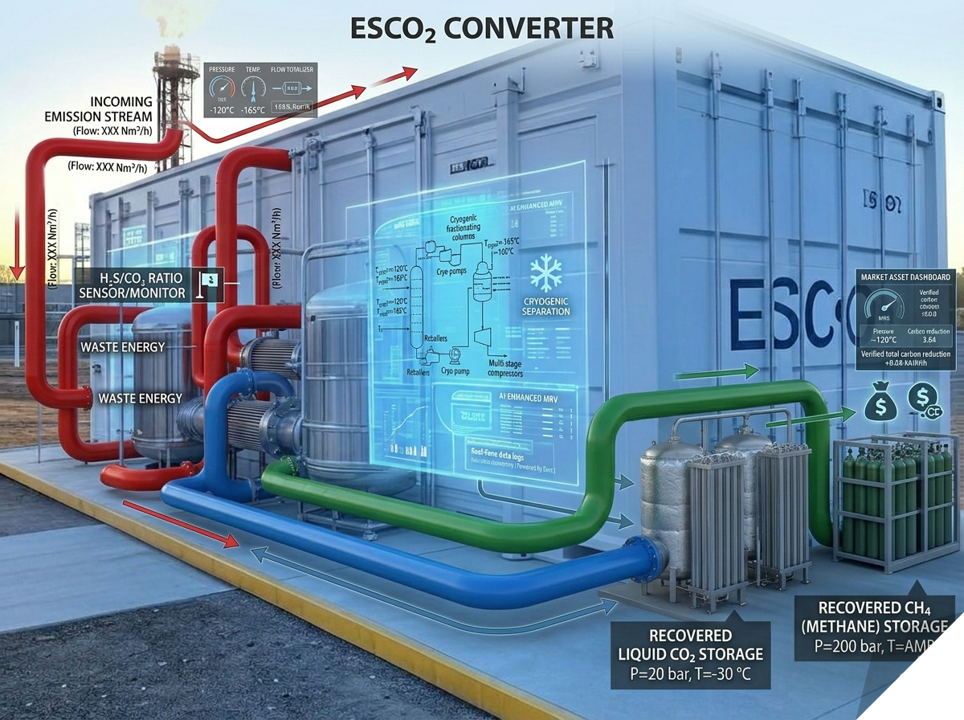
At the core of our offering is the ESCo2 Converter (ESC). A scalable, modular cryogenic refrigeration system that captures, cools, separates, and liquefies greenhouse gases. Powered by AI and quantum sensors, it delivers real-time optimization of gas composition and flow.
Core Advantages:
Efficiency: 60 - 80% lower energy consumption than traditional refrigeration.
Zero Super Pollutants: 100% free of CFCs, HFCs, or HCFCs.
Scalability: Modular units ranging from 10L to 1,000MCF+.
Precision: AI & quantum sensor-driven real-time flow optimization.
Deployment:
Based on standard practices in the oil and gas industry for modular, containerized process systems, the deployment of the ESCo2 system offers significant advantages in speed and spatial efficiency. A brief overview of the footprint, installation time, and site requirements is provided below.
Efficiency
The central process unit of the ESCo2 converter is housed within a standard ISO shipping container, typically a 40-foot High-Cube configuration. This creates a highly compact "core" footprint. However, a functional site includes key ancillary equipment such as compression skids, product storage tanks (for liquefied CO2 and compressed Methane), and utility connections. A representative deployment would require a dedicated, structured area to accommodate the core unit, maintain safe hazardous area separation, and allow for vehicle access for product load.
Installation Time
The modular "Plug & Play" design fundamentally compresses the onsite timeline compared to traditional "stick-built" gas processing plants, shifting the majority of construction labor to a controlled factory environment. Onsite installation is focused on integration, not fabrication. From mobilization to full commercial operation, a typical site deployment can be completed in 2 to 4 weeks.
- Site Preparation: Concurrently with factory testing. (1-2 weeks)
- Mobilization and Positioning: Units arrive and are lifted onto foundations. (2-4 days)
- Mechanical and Electrical Tie-ins: Process, utility, and power connections are made. (1-2 weeks)
- Commissioning: System flush, leak test, and final process tuning. (3-7 days)
This expedited process is critical for minimizing site disruption at active refinery, power, or wellhead locations.